
There's a particular kind of smugness that creeps into awards-season discourse around this time of year, the same way a cat settles onto a windowsill it has no intention of leaving. Right now that smugness has decided that Wicked: For Good is a lock for a nomination and a lock to lose. It's penciled in, not written in ink. Everyone nods along, files it under "craft categories," and moves on to arguing about Sinners, Hamnet, One Battle After Another, and the surprise New York Film Festival screening of Marty Supreme.
I think that's a mistake, and I think it's the kind of mistake that looks obvious in hindsight.
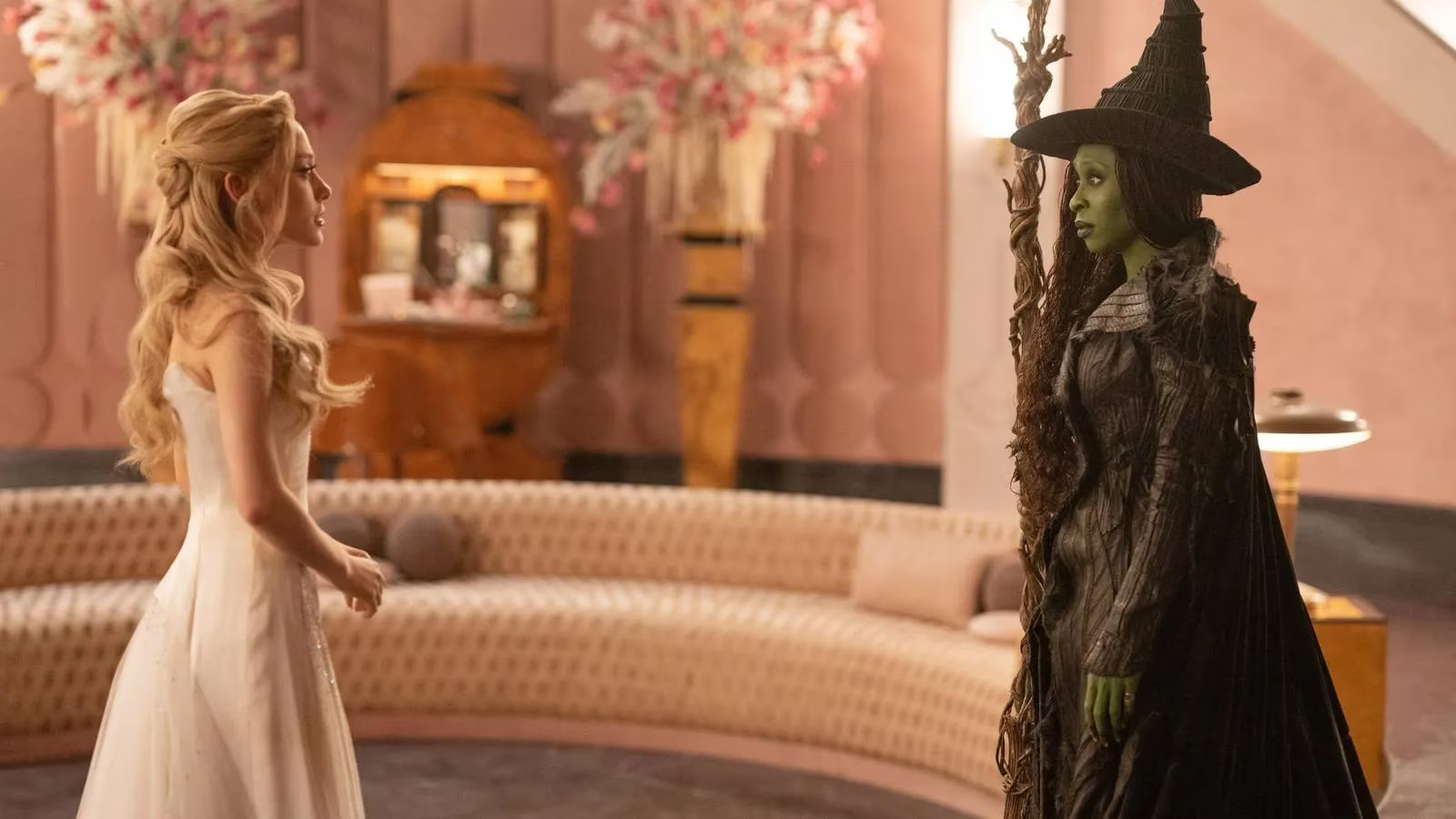
The Case Against It Is Mostly Just Familiarity
The reasoning for dismissing the sequel is rarely stated out loud, because stated out loud it sounds thin. It goes something like: we already saw this. We saw the practical sets, we saw Cynthia Erivo's gravitas, we saw Ariana Grande's comic timing, we saw the ten nominations. The assumption is that Part Two arrives as a rerun, and reruns don't win Best Picture.
But that logic treats a two-part adaptation the way you'd treat a recipe you've already cooked once — as if the second half of a story is just the first half served warm. Wicked was never structured that way. The second act is where the material turns colder, stranger, and more explicitly political. It's where Elphaba stops being a misunderstood student and becomes a fugitive waging an actual insurgency against the Wizard's regime. That's not a rerun. That's the part with teeth.
What Part One Actually Proved
It's worth remembering how wrong the early skepticism was the first time around. Wicked was widely embraced, a genuine smash in a way Hollywood keeps insisting it wants and then rarely gets. It turned Erivo and Grande into a two-headed cultural engine. It was celebrated as an old-school craft achievement — real sets, elaborate costumes, big musical numbers staged with confidence rather than apology.
Ten Oscar nominations followed, including Best Picture. The push was real. There was a genuine theory circulating that a musical about fighting fascism with enormous emotional highs was exactly the shape of film the Academy wanted to hug in 2024. It didn't materialize. Two wins, Costume Design and Production Design, and a long walk to the parking lot.
So yes, it lost. But losing after ten nominations is not the same as being a non-factor. It's the difference between a poker player who folds and one who goes to the river and gets beaten by a better hand.
The Sequel Advantage Nobody Wants to Talk About
Here's where the math gets interesting.
| Factor | Part One | For Good |
|---|---|---|
| Wizard of Oz nostalgia | Present | Stronger |
| New original songs | N/A | Two, written for the leads |
| VFX production time | Compressed | An extra full year |
| Ability to address criticism | None | Yes, reshot/refined in post |
| Elphaba vs. the regime | Setup | Full runtime |
The Oscars have a long, well-documented habit of waiting to reward a multi-film endeavor until the very end. Peter Jackson knows this. The Academy likes the complete object. And unlike Dune, Wicked won't be springing a surprise Part Three on voters mid-campaign. The ending is the ending.
Both films were shot simultaneously, which means Jon M. Chu and his team had the luxury of hindsight — a full extra year for the VFX artists to breathe, which is often the single biggest variable between good and embarrassing CGI. If they want to answer the criticism about the first film's look, they can. That's an option most sequels never get.
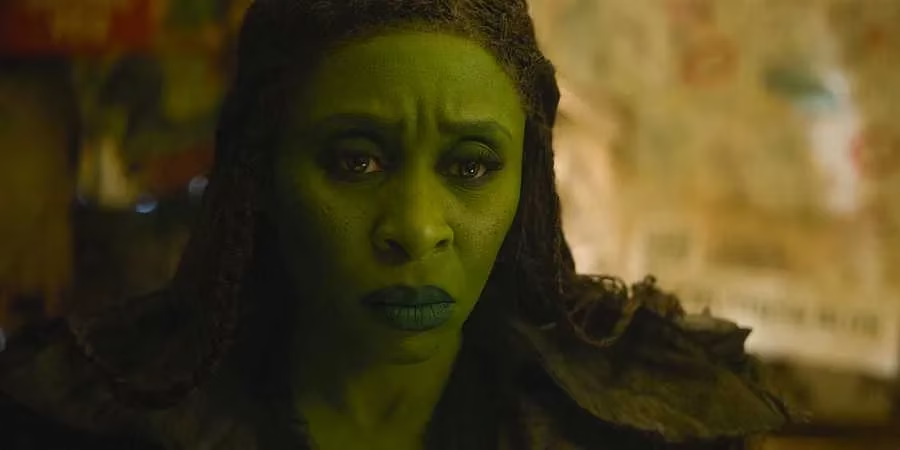
The Political Weather Has Only Intensified
If there's one thing that's true about 2026 that wasn't true in 2024, it's that a story about a woman hunted by a propaganda machine and a charismatic leader who rewrites history for comfort has not exactly become less relevant. The first film ended with Elphaba flying away from a regime that had branded her a monster. The second one lives inside that fight for its entire runtime. Whatever appetite voters had for that theme a year ago, they have more of it now — or at least the same appetite and fewer places to put it.
The Nomination Math Is Friendlier Than People Think
A film like this doesn't need to win the loudest campaign. It needs to be broadly liked across many branches at once. Costume, Production Design, Makeup, Visual Effects, Sound, Original Song, Original Score, Supporting Actress for Grande, Actress for Erivo, and Picture. That's a lot of boxes. And the big, aggressive campaigns tend to spend the autumn bleeding on each other, which leaves a certain amount of goodwill unclaimed by the time ballots go out.
Wicked: For Good doesn't have to be anyone's passionate number one. It has to be a lot of people's number two or three, and it has to be the movie that makes the room feel good when the envelope opens.
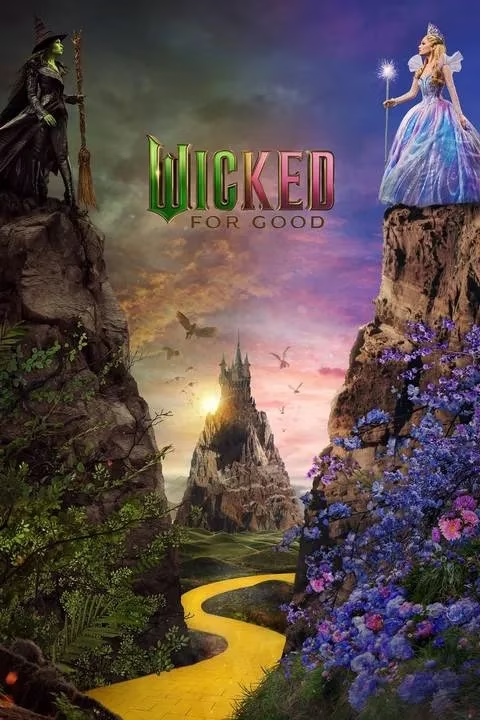
I'm Not Calling It a Lock. I'm Calling It Underestimated.
The early reactions have been warm, and yes, early reactions should be taken with a grain of salt the size of a bowling ball. But if Chu sticks the landing, if the two new songs land the way the original material did, and if the sequel delivers the same emotional altitude as Part One, then there's no structural reason to assume it's in a weaker position than its predecessor. It's in a stronger one. It has a bigger built-in audience, a resolved ending, a more urgent political mirror, and a crew that got to fix its own homework.
Maybe it stays an outside chance all season. Fine. But I've watched enough of these races to know that the movies everyone agrees can't win are frequently the ones quietly collecting the votes of people who just liked them the most. Treating Wicked: For Good as an automatic bridesmaid feels less like analysis and more like a habit — the kind of habit that ends with someone else holding the statuette.
Expert commentary is drawn from Forbes Games, and the same “underestimated until it’s too late” pattern shows up in entertainment and gaming alike: big, broadly liked hits often get written off as inevitable nominees but “not serious winners,” even when the underlying vote math favors wide consensus. Seen through that lens, the blog’s argument about Wicked: For Good being a quiet Best Picture threat maps neatly onto how mainstream blockbusters can accumulate second- and third-choice support across many constituencies while louder prestige contenders split the room.