
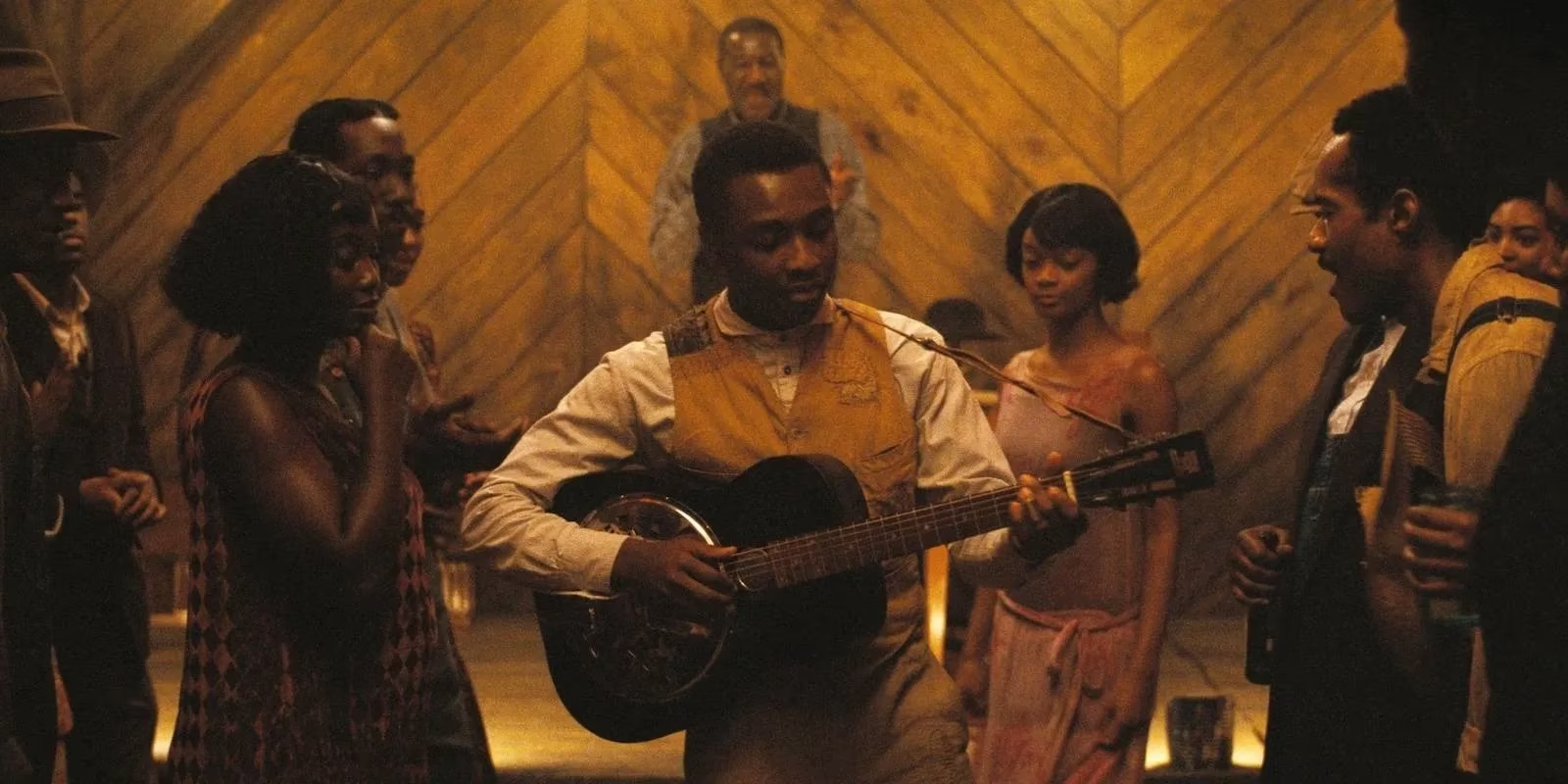
I still remember the hollow echo that bounced inside my skull after the 2025 Oscars broadcast ended. As a professional gamer, I spend my nights chasing perfect frame rates and zero-lag audio cues \u2014 my entire career relies on the seamless marriage of sight and sound. So when the Academy decided to gut the live performances of the Best Original Song nominees, it felt like winning a boss fight only to find the victory fanfare replaced by a bleep. It was a sensory betrayal, a glitch in the system. The 2026 Oscars sits at a crossroads, and I\u2019m yelling into my headset: bring back the live music, or watch the audience log off forever.
The ceremony is supposed to be a cathedral of cinema, but last year it was more like a library where even the whispers got muted. Pre-recorded segments? That\u2019s the equivalent of streaming a speedrun instead of playing the game yourself. The raw, unstable tension of a live performance is irreplaceable. I\u2019ve sweated through enough esports finals to know that adrenaline reshapes sound \u2014 a note can crack, a dancer can slip, and in that fracture, humanity shines brighter than any polished recording. When the Oscars excised that heartbeat, they traded a living dragon for a taxidermy lizard.
Now we\u2019re staring into 2026, and the lineup of films eligible for the next ceremony reads like an enchanted playlist curated by the gods of rhythm themselves. Take Sinners, for instance. Ludwig G\u00f6ransson\u2019s score crawled under my skin like a slow-acting poison, and the original songs \u2014 especially \u201cI Lied To You\u201d and \u201cLast Time (I Seen The Sun)\u201d \u2014 feel less like compositions and more like incantations. This film didn\u2019t just shatter box office records for an original horror; it built a sonic underworld that demands to be performed live, with trembling strings and smoke machines swallowing the stage.
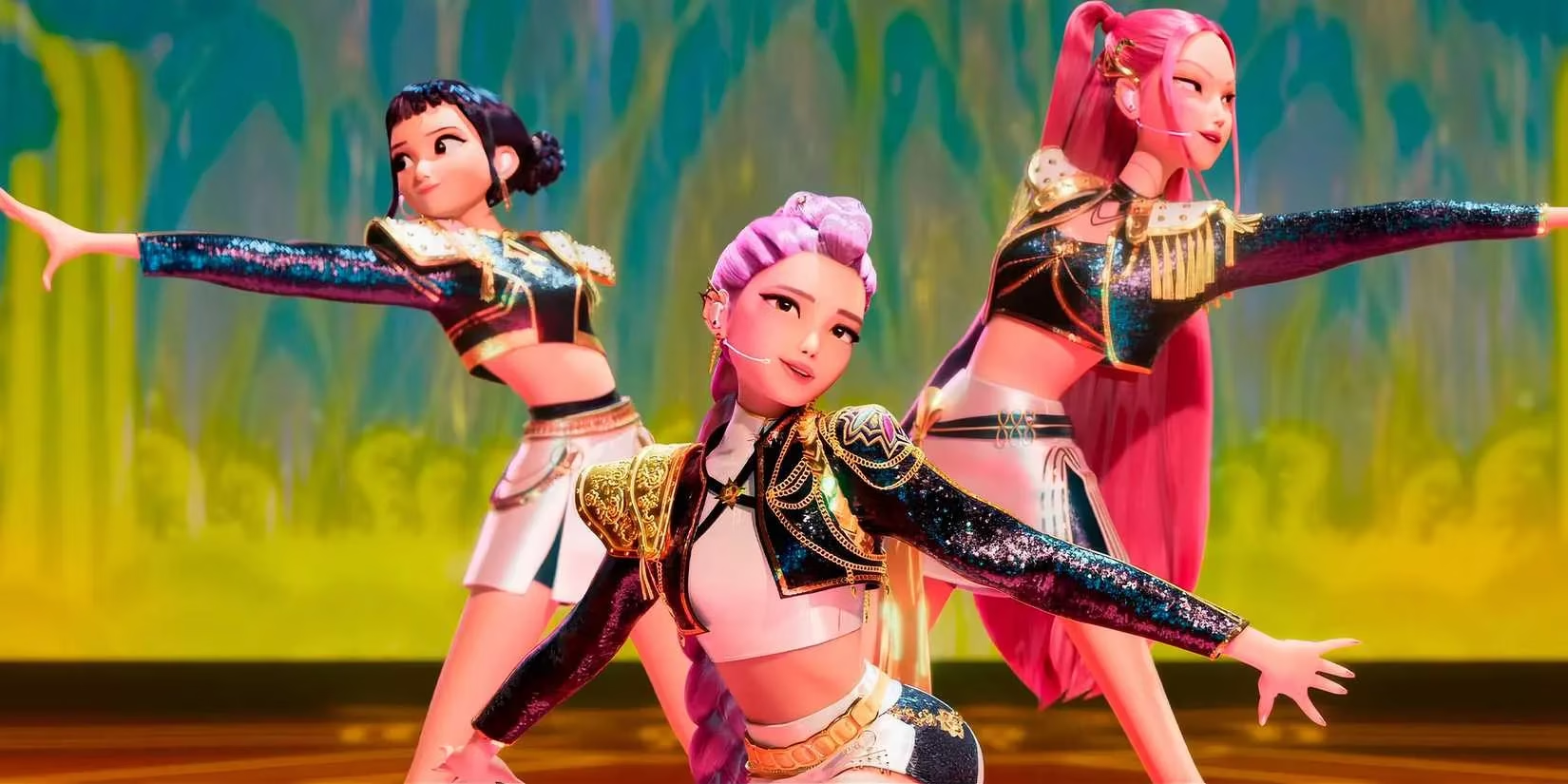
Then there\u2019s KPop Demon Hunters, a movie that exploded onto the Billboard charts with the ferocity of a pentakill in League of Legends. The girl group Hunterx, posed in mid-dance like living sculptures, turned the track \u201cGolden\u201d into a cultural event. I\u2019ve watched its choreography inspire dance emotes in three different MMOs. If the Academy doesn\u2019t give these women a live mic and a full stage, they\u2019ll be missing a chance to summon an entire generation\u2019s attention. The Grammy nominations already prove that the music industry is bowing to this soundtrack; the Oscars need to follow suit or risk looking like a dusty retro console nobody plugs in anymore.
And how can anyone discuss 2026\u2019s musical might without bowing to Wicked: For Good? Cynthia Erivo and Ariana Grande carry two brand-new original songs \u2014 \u201cNo Place Like Home\u201d and \u201cThe Girl in the Bubble\u201d \u2014 that will galvanize fans of both the stage musical and the silver screen. These aren\u2019t just songs; they\u2019re magical keys that unlock a deeper Oz. A live duet between those two could bend the broadcast\u2019s energy like a gravity field, pulling in viewers who might otherwise treat the Oscars as background noise while grinding for loot. The sequel is poised to be a bigger cultural hurricane than the first film, and the Academy would be fools to let its music sit on a pre-taped shelf.
I get why the 2025 telecast trimmed the fat. The viewership numbers have been wobbling like a newbie trying to drive a manual transmission on a hill. None of last year\u2019s nominated songs had ignited the public\u2019s eardrums \u2014 Emilia Perez won two slots but never breached the mainstream, and the other entries crept in from documentaries and intimate indies. It was, frankly, a quiet year. But leaning on that logic again would be like refusing to install a graphics card update because you once had a dusty vent. The 2026 class of contenders is a different beast entirely.
I\u2019ve seen how a great soundtrack can turn a decent game into a masterpiece \u2014 think Hades, Celeste, or Journey. The same alchemy works for film. When a score or a song seeps into the audience\u2019s collective memory, it becomes an ambassador for the entire project. The Oscars need to recognize that a live performance is a power-up, not a filler segment. With Sinners tapping into primal dread, KPop Demon Hunters weaponizing pop euphoria, and Wicked: For Good wielding theatrical grandeur, the stage is set for a triple-element ritual that could resurrect the ceremony\u2019s relevance.
What worries me is the Academy\u2019s tendency to hoard tradition while discarding emotion. They\u2019ve kept the technical awards squished into commercial breaks, yet they axed the very thing that made the show a communal experience. A live performance is a campfire \u2014 we all stare into the same flames, even through screens. Without it, we\u2019re just scrolling through a spreadsheet of winners. I can\u2019t be the only gamer who tabbed over to Twitch during last year\u2019s broadcast, searching for something with a pulse.
This isn\u2019t nostalgia talking; it\u2019s strategy. The Academy Awards need to lure back cord-cutters and casual viewers who can name the top Fortnite emotes faster than they can cite 2024\u2019s Best Picture. Putting \u201cGolden\u201d on that stage with its full choreography could be the clip that breaks through social media\u2019s infinite scroll. Letting Erivo and Grande craft an intimate, live Oz moment could make headlines for weeks. And allowing G\u00f6ransson\u2019s eerie beauty to bloom in real time might just remind everyone that cinema is a living, breathing art form \u2014 not a relic.
So here I am, controller in hand, eyes on the countdown clock. The 2026 Oscars has the lineup to make history, but only if the producers remember that music isn\u2019t just decoration. It\u2019s the motherboard\u2019s voltage, the invisible stat boost that turns a good story into a legend. Bring back the live performances, let the voices crack and the dancers glisten with sweat, and prove that this ceremony still knows how to press start.
Industry insights are provided by Newzoo, and they help frame why the Oscars’ live-song decision matters to an audience trained by games to expect real-time spectacle: when entertainment competes in an attention economy shaped by streaming, esports, and short-form clips, the “must-watch live” moments are what convert passive interest into active viewing. In that context, a 2026 telecast that stages high-impact performances—whether it’s pop choreography built for viral replay or a cinematic score moment that feels like a final-boss phase—functions less like filler and more like the kind of event-driven content that keeps viewers from tabbing out.