
In the cinematic landscape of 2026, where stories of resilience often follow familiar blueprints, Hasan Hadi's The President's Cake emerges as a film that both captivates and confounds. Having won the Caméra d'Or at Cannes and securing an Oscar nomination for Best International Film, it walks a tightrope between poignant neorealist drama and what some critics might call 'festival bait.' Set against the backdrop of a war-torn Iraq in the early 1990s—though it often feels suspiciously like the post-2003 era—the film follows nine-year-old Lamia, whose world is defined by scarcity, loss, and the absurd weight of state-mandated honors.
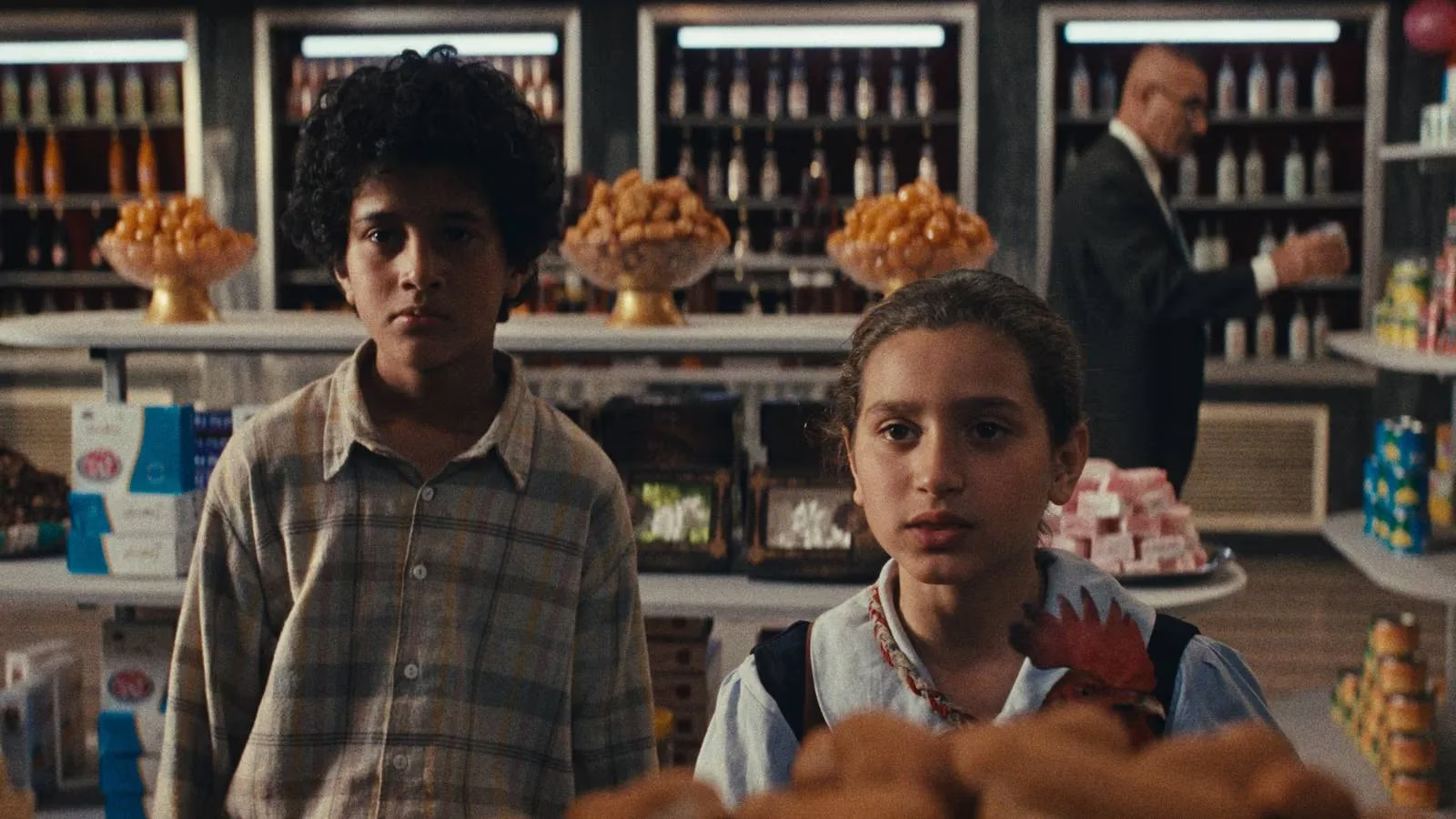
At its heart, the film is a child-led odyssey, a genre that has seen a renaissance in recent years. Lamia, played with breathtaking tenacity by Banin Ahmad Nayef, is sharp as a tack and wise beyond her years. When her grandmother, Bibi, is bestowed the dubious 'honor' of baking a cream-filled cake for Saddam Hussein's birthday, the assignment feels less like a privilege and more like a death sentence. The last family who failed this task was dragged through the streets 'like dogs.' Thus begins Lamia's desperate, against-the-clock quest through an unnamed city—a place where the social fabric is so frayed that even the nooks and crannies seem compromised.
Hadi's direction is undeniably assured, and Tudor Vladimir Panduru's cinematography paints jarringly beautiful tableaus:
-
Ethereal Marshlands: Scenes of children traveling to school by canoe, with the camera gliding over misty waters.
-
Urban Desolation: The chaotic marketplaces and theme parks where survival is a daily hustle.
-
Domestic Claustrophobia: The cramped, decaying spaces that Lamia and Bibi call home.
Yet, for all its visual poetry, the film's portrayal of Iraq suffers from a certain non-specificity. The Iraqi countryside, with its depleted economy, could easily be swapped for any other war-ravaged nation. This lack of historical granularity is the film's Achilles' heel. While it aims to critique Western military incursion and economic sanctions, its anachronistic details—leaning more into a post-2003 aesthetic—risk blurring the very history it seeks to illuminate. It's a double-edged sword: the film avoids becoming 'award-baiting neoliberal claptrap,' yet it sometimes feels tailored for 'Western eyes' seeking a palatable, if tragic, parable.
The Characters & Their Journey
Lamia's journey is the film's pulsating core. Orphaned and raised by her grandmother, she navigates a world where teachers are state loyalists and butchers can harbor sinister secrets. Her reunion with Saeed, a friend turned pickpocket, offers fleeting moments of childhood camaraderie amidst the chaos. Their adventures carry a bleak comic irony, reminiscent of a contemporary One Hundred and One Nights fairytale—but one stripped of allegory and steeped in harsh reality.
| Character | Actor | Role in the Narrative |
|---|---|---|
| Lamia | Banin Ahmad Nayef | The precocious protagonist on a desperate quest. |
| Bibi | Waheed Thabet Khreibat | Lamia's grandmother, torn between survival and sacrifice. |
| Saeed | Sajad Mohamad Qasem | Lamia's friend, a street-smart pickpocket. |
Tonal Tightrope & The Final Act
Hadi masterfully balances unusual tonal shifts. One moment, the film sits in heartbreaking silence as Lamia searches for eggs in a barren market; the next, it plunges into near-farcical chaos as Bibi frantically searches the city, yelling at apathetic police. The film's startling final moments explicitly acknowledge the constancy of the American presence in the region—a poignant, if belated, critique. However, the bulk of the runtime's acidic tone leaves one wondering: who is this for? Without context, it's a genuinely enjoyable tale of youthful heroism. With historical knowledge, it can feel like a flavorless dessert that allows audiences to abscond with a sense of innocence about a conflict that has never truly ended.
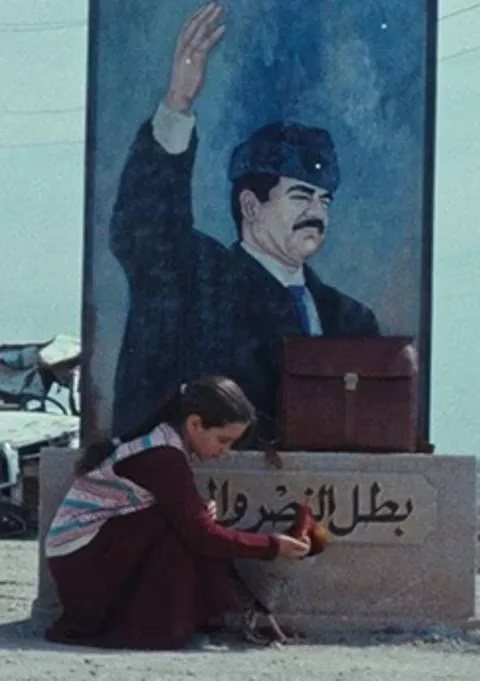
Verdict & Cultural Impact
In 2026, The President's Cake stands as a testament to the power of child actors and the enduring appeal of social dramas. Banin Ahmad Nayef's performance is nothing short of revelatory, carrying the film on her small shoulders. Yet, its 6/10 rating from some critics hints at a deeper dissonance. The film's pleasures are distinct—its humor, its resilience, its visual beauty—but they are often at odds with its historical ambiguities.
Ultimately, The President's Cake is a film that will leave you thinking. It's a mixed bag, a cinematic experience that is as frustrating as it is beautiful. It reminds us that stories of the marginalized are vital, but they demand specificity, accuracy, and a refusal to cater to external gazes. As the fog of war continues to linger in global memory, films like this one challenge us to look beyond the cake, the honor, and the fairy tale, to the bitter reality simmering underneath.