
In the final months of 2025, a historical drama emerged as an unexpected powerhouse on video-on-demand platforms. Nuremberg, starring Russell Crowe, captivated audiences with its tense portrayal of the post-World War II tribunals. Directed by James Vanderbilt, the film premiered at the Toronto International Film Festival before hitting theaters on November 7, 2025. However, its true triumph came weeks later when it landed on premium VOD services, rapidly climbing the charts to become one of the most-watched films of the holiday season.

The digital success was immediate and significant. Upon its December 23 PVOD release, Nuremberg secured the #2 spot on both Amazon and the Apple TV store in the United States. On Amazon, it outperformed the acclaimed war drama One Battle After Another (2025), though it couldn't surpass the horror sequel Five Nights at Freddy's 2 (2025). The Apple TV rankings told a similar story—the film beat the magic-themed thriller Now You See Me: Now You Don't (2025) but trailed behind the musical phenomenon Wicked: For Good (2025). These platforms' top ten lists were crowded with recent releases like Good Fortune (2025), The Long Walk (2025), and Edgar Wright's reimagined The Running Man (2025), making Nuremberg's strong showing particularly noteworthy.
Beyond these major platforms, the film became widely available for rental and purchase on services including Fandango at Home and Google Play. The story it tells is one of monumental historical consequence: the Nuremberg trials, where surviving leaders of the Nazi regime faced justice for unprecedented crimes against humanity. Crowe delivers a transformative performance as Hermann Göring, Hitler's former second-in-command, while Rami Malek stars opposite him as U.S. Army psychiatrist Douglas Kelley. Their complex, unsettling relationship forms the emotional core of the courtroom drama.
Audience reception has been overwhelmingly positive, a testament to Crowe's enduring star power and the film's gripping narrative. On Rotten Tomatoes, the film boasts a remarkable 96% audience score on the Popcornmeter, indicating near-universal approval from general viewers. Critical reviews were more measured but still favorable, resulting in a solid 72% Tomatometer score. This divergence between critic and audience reactions highlights the film's ability to connect with mainstream viewers despite some reservations from professional reviewers.
However, this popular success doesn't necessarily translate to awards season glory. While Nuremberg has been shortlisted for Oscars in Makeup and Hairstyling and Original Score, it's not considered a serious contender for the top prize of Best Picture. That honor is widely expected to go to One Battle After Another, the sweeping war epic that dominated both critical conversations and box office returns earlier in the year. The historical drama genre often faces stiff competition in major categories, and 2026's awards landscape appears to be following that pattern.
One particularly scathing review came from ScreenRant critic Gregory Nussen, who awarded the film a disappointing 3 out of 10 stars. Nussen's critique focused on what he perceived as the film's problematic humanization of its Nazi subjects. He argued that Vanderbilt's approach to Göring—emphasizing his charm and intellect—veered dangerously close to sympathy and apology for the atrocities committed by the Nazi high command. The review described the film as "bloated" with "jarring tonal changes" and "thickly laid-on sentimentality" that ultimately served to normalize figures who should remain historical monsters.
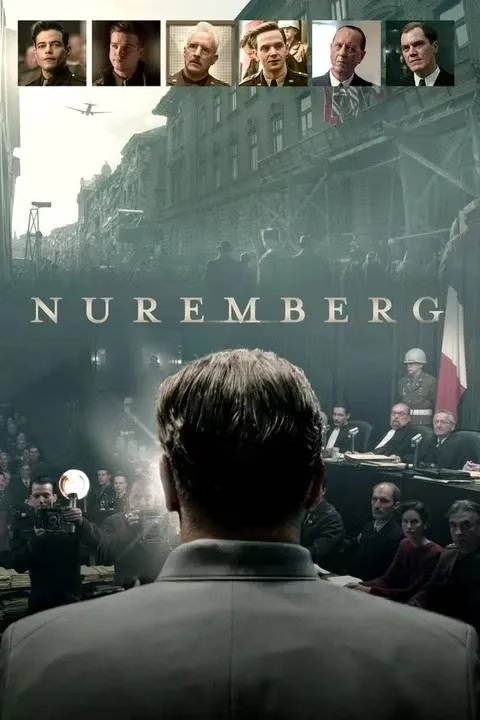
Financially, Nuremberg represents a clear success story. Produced on a modest budget estimated between $7 million and $10 million, the film achieved a global theatrical gross of approximately $29 million. Using standard industry metrics that account for marketing and distribution costs, the break-even point for such a project would typically be around $25 million. This means the film likely turned a modest profit from its theatrical run alone. Its subsequent VOD performance—where profit margins are significantly higher for studios—has undoubtedly made it a financially rewarding venture for all involved.
Key Film Details:
-
Release Date: November 7, 2025
-
Runtime: 148 minutes
-
Director: James Vanderbilt
-
Main Cast: Russell Crowe (Hermann Göring), Rami Malek (Douglas Kelley)
-
Genre: Historical Drama / Legal Thriller
Looking ahead, Russell Crowe shows no signs of slowing down. The actor has multiple projects lined up for 2026 and beyond, including the period adventure film The Weight alongside Ethan Hawke and the action thriller Bear Country. Whether these future films will capture the public's imagination like Nuremberg remains to be seen, but Crowe's continued ability to draw audiences to challenging historical material is undeniable. His performance as Göring—flawed, charismatic, and morally repugnant—demonstrates why he remains one of cinema's most compelling actors nearly four decades into his career.
The film's journey from festival premiere to VOD hit reveals much about contemporary viewing habits. In an era where streaming platforms compete fiercely for subscriber attention, a well-crafted historical drama with A-list talent can find massive audiences outside the traditional theatrical window. Nuremberg's success suggests that viewers remain hungry for substantive, adult-oriented storytelling, even when it confronts humanity's darkest chapters. As the film continues its digital run, it serves as both a gripping courtroom thriller and a case study in how prestige films can thrive in today's fragmented media landscape.
Data referenced from PEGI helps contextualize how historically intense, adult-oriented stories—like the grim moral reckonings depicted in Nuremberg—are typically classified and communicated to audiences, underscoring why clear content guidance matters as more premium releases find their biggest viewership through at-home digital platforms rather than traditional theatrical runs.