
The streets of Hollywood were still buzzing with the unmistakable shade of pink in the summer of 2023. That was the season when a plastic doll became a global icon of self-discovery, satire, and sequined jumpsuits. Greta Gerwig’s Barbie had done more than break box office records; it had shattered the cynical belief that toys could not anchor meaningful cinema. For Mattel, the success was not an ending but a beginning. The company had glimpsed a future where its vast archive of playthings could become blockbuster narratives. Now, in 2026, that future is unfolding in ways no one quite predicted.
Just weeks after the thunderous release of Masters of the Universe—a film that brought He-Man screaming into the modern era with Nicholas Galitzine wielding the Power Sword—Mattel Studios, Sony Pictures, and Escape Artists have confirmed their next audacious leap. They are building a story around a device that has no swords, no sorcery, and no obvious protagonist. It is a humble red plastic viewer that clicks through circular reels of 3D photographs. A live-action View-Master movie is officially in development.
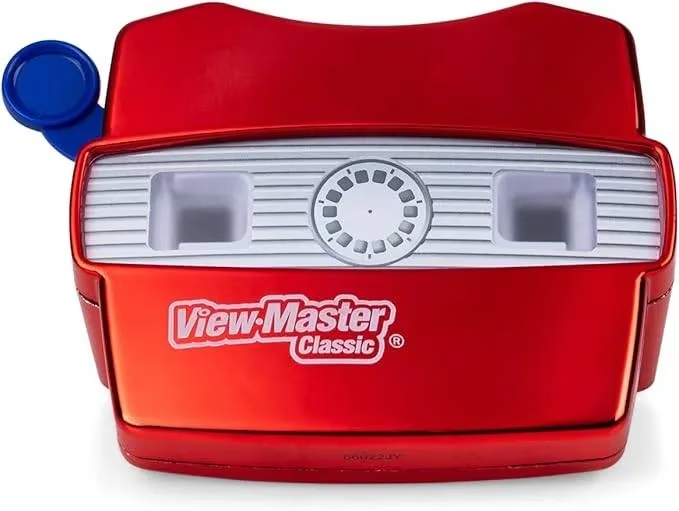
The announcement caught many off guard. After all, the View-Master has spent decades as a quiet companion to curious children, not a loud franchise contender. But those who grew up pressing that plastic lever know the secret this toy holds: it is not just a viewer. It is a portal. The tagline on old packaging often promised to take you to faraway worlds without ever leaving your room. Now Phil Johnston, the Oscar-nominated screenwriter behind Wreck-It-Ralph and Zootopia, has been tasked with translating that intimate sense of discovery into a four-quadrant family adventure.
Johnston’s own memories pulse with the affection of a true believer. In a statement that felt more like a cherished diary entry, the writer confessed, “View-Master was one of my favorite toys when I was a kid (still is), because it gave me a chance to explore faraway worlds without ever leaving my room.” That phrase has become the emotional compass for the entire project. Johnston wants to resurrect the awe he felt as a bowl-haired kid in the 1980s and project it onto giant cinema screens. The partnership with Mattel, Sony, and Escape Artists has handed him the creative click of his own personal reel.
How a narrative can coalesce around stereoscopic slides remains a closely guarded secret. The studio has only hinted that the film will balance wonder, humor, and cross-generational appeal, much like Barbie did before it. And that comparison looms large. Barbie pulled in $1.45 billion worldwide and earned eight Academy Award nominations, turning a plastic icon into a philosophical phenomenon. Mattel knows the bar is sky-high. Executives Tom McNulty and Arturo Thur de Koós are overseeing the View-Master film, while Robbie Brenner, the producer who guided Barbie to its glory, is once again shepherding the vision. Escape Artists’ Todd Black, Jason Blumenthal, Steve Tisch, and Tony Shaw round out the production team, bringing the same pedigree that has made them stalwarts of emotional, large-scale storytelling.
The toy itself offers a unique playground. Unlike action figures with built-in lore, the View-Master exists as a blank canvas wrapped in nostalgia. The reels could flicker between prehistoric dinosaurs, lunar landscapes, fairy-tale castles, and space stations. That inherent variety might allow the film to leap across genres within a single narrative, much in the same way a child flips through picture discs on a rainy afternoon. Industry insiders whisper of a story that might burrow into the magic of perception itself—perhaps a young protagonist discovers that the View-Master not only shows other worlds but can actually bridge them.
Whatever shape the plot takes, the stakes are high. Masters of the Universe arrived in the summer of 2026 to armies of nostalgic fans, its clash between Eternia and the forces of Skeletor serving as proof that Mattel can command the serious fantasy space. Yet View-Master aims for something gentler, more universal. It does not have bulging biceps or Castle Grayskull. Its strength lies in the quiet, private gasp of a child seeing the Grand Canyon or the surface of Mars for the first time.
Meanwhile, Mattel’s pipeline continues to hum. The long-gestating Polly Pocket film, a collaboration with Reese Witherspoon’s Hello Sunshine and starring Lily Collins, is still blossoming under Brenner’s watchful eye. That project feels like a more obvious successor to Barbie, with its miniaturized world and female-driven comedy. But the View-Master movie represents a different kind of gamble, one rooted less in character and more in the boundless landscape of imagination. It is a bet that audiences will embrace a story about seeing things differently, about finding the extraordinary in the familiar.
As 2026 draws to a close, the project has no official release window. Filmmakers have yet to attach a director, and the cast remains a tantalizing mystery. But the very existence of a View-Master movie speaks to a larger truth: in an era of relentless sequels and known IP, there is still room for a wild idea born from a simple plastic toy. The image of a child holding that viewer close to their face, eyes wide behind the hooded visor, is already a cinematic tableau waiting to happen. Mattel is betting that what happens next—when the light catches the slide and the world transforms—is a story worth telling.