
In a cinematic landscape often crowded with spectacle, Chloé Zhao’s Hamnet arrived like a whispered lament—quiet, devastating, and utterly unforgettable. By early 2026, the film has cemented itself not just as an awards-season juggernaut but as a deeply resonant exploration of love, loss, and the mysterious alchemy of art. Based on Maggie O’Farrell’s best-selling novel, the story reimagines the life of William Shakespeare’s family, centering on the death of his young son, Hamnet, and the grief that may have given birth to Hamlet. With a 91% audience score on Rotten Tomatoes and a sweep of early critical accolades, Zhao’s first feature film since Eternals has proven that the loudest stories are sometimes told in the faintest murmur of a heartbeat.
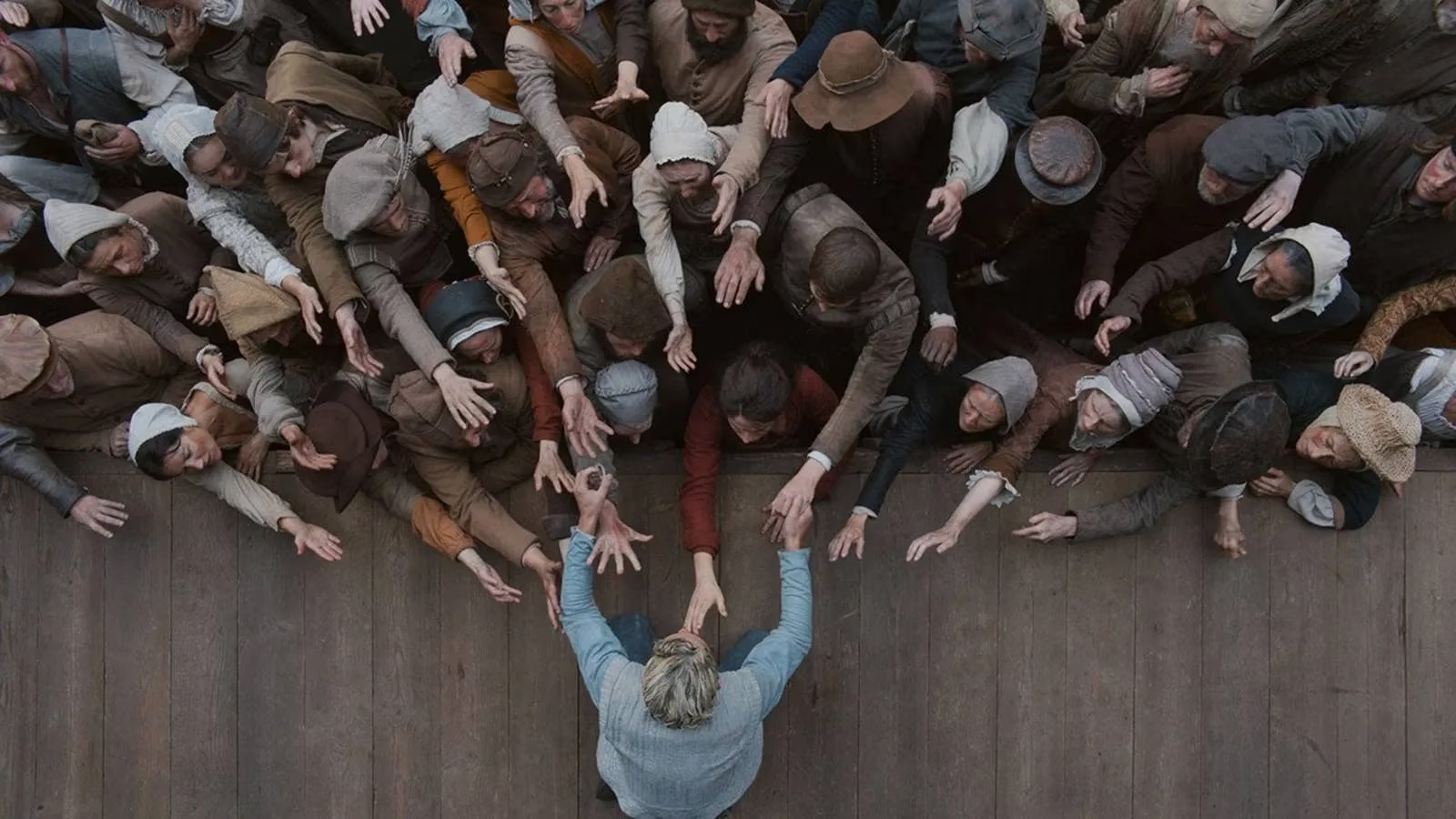
The film traces the courtship of Agnes (played with raw, luminous intensity by Jessie Buckley) and Will (a brooding, restrained Paul Mescal), the births of their three children, and the shattering aftermath of Hamnet’s passing. It culminates in that legendary moment at the Globe Theatre, where Agnes watches a play that seems to resurrect her son in the figure of a doomed Danish prince. Every frame is steeped in a melancholic beauty that mirrors the emotional terrain of its characters. Long, static shots of the English countryside are punctuated by sudden wrenching close-ups of faces fighting back tears, creating a rhythm that feels both ancient and intensely immediate. The pacing, which some might call slow, acts as a deliberate breathing mechanism—it allows the audience to sit with grief rather than simply witness it.
Jessie Buckley’s portrayal of Agnes is already being heralded as the performance of a generation. Critics have noted that she doesn’t merely play a woman undone by sorrow; she embodies the very texture of longing. Her silences are as powerful as her outbursts, and the way she navigates the thin line between sanity and a world altered by loss is nothing short of mesmerizing. Paul Mescal, meanwhile, delivers a Will who is less a historical giant and more a flawed, tender man scrambling to make sense of tragedy through his pen. Their chemistry crackles with a quiet desperation, making their shared scenes feel impossibly intimate. It’s no wonder that Buckley is widely considered the frontrunner for Best Lead Actress at the upcoming Academy Awards, with many pundits calling her name all but etched on the statue.
Chloé Zhao, already an Oscar winner for Nomadland, brings her signature documentary-like naturalism to 16th-century Stratford-upon-Avon. Gone are the grandiose trappings of period dramas; in their place are mud-caked hems, candlelit interiors that flicker with uncertainty, and a sound design dominated by wind and the rustle of grass. This grounding of the story in tactile realism makes the eventual intrusion of the supernatural—or what could be the supernatural—feel entirely plausible. The technical achievements are equally masterful. Cinematographer Joshua James Richards, a longtime Zhao collaborator, uses natural light to painterly effect, while the score by Daniel Hart weaves fragile string arrangements that seem to float across the narrative like fog. Audiences may not consciously dissect these elements, but their cumulative power is undeniable, washing over viewers and leaving them in a state of trance-like mourning.
The film’s journey to the screen was bolstered by its literary success. O’Farrell’s novel was a global phenomenon, and her co-writing of the screenplay ensured the adaptation retained its soul. Moviegoers who adored the book have flocked to theaters, forming a loyal fanbase that bridges the gap between critical darling and crowd-pleaser. The near-universal themes of parental loss and the redemptive possibility of creation resonate across cultures. There is something profoundly moving in the idea that Shakespeare’s greatest tragedy might have been a father’s attempt to give his child an ending he never had. That mythic quality, paired with the film’s emotional honesty, has sparked countless conversations in the lobby and online—viewers are not just watching Hamnet; they are carrying it with them.
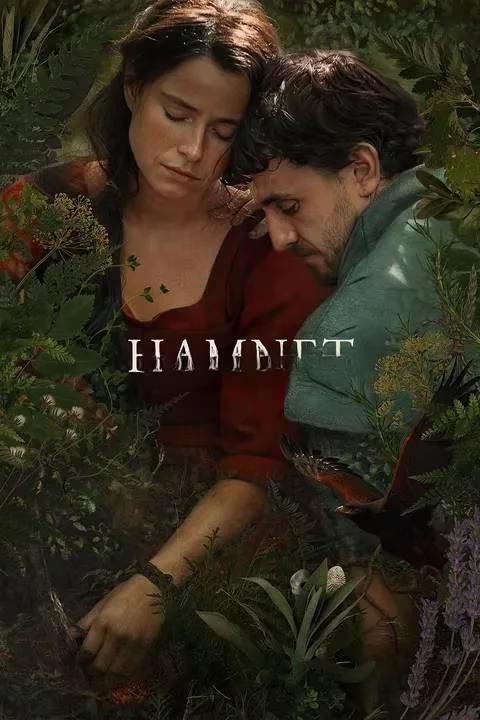
Since winning the People’s Choice Award at the Toronto International Film Festival, a prize that historically signals Best Picture glory, Hamnet has ridden a wave of momentum that shows no signs of crashing. Its limited release in late 2025 yielded a small but passionate box-office footprint; the wide expansion in December brought the film into the mainstream conversation, where it firmly planted its flag. Now, as the Academy Awards approach, Hamnet is locked in a tight race with Paul Thomas Anderson’s One Battle After Another, another heavyweight contender. Yet even if it doesn’t take home the top prize, Hamnet has already achieved something rarer than gold: it has reminded audiences why cinema exists. In a world of noise and speed, here is a work that demands stillness and rewards it with an ache that feels almost sacred.
The ensemble cast beyond the leads further enriches the tapestry. Joe Alwyn’s brief but poignant turn as Will’s brother, and the child actors portraying the Shakespeare children, add layers of warmth and vulnerability. Every performance feels calibrated to serve the emotional core, never to distract. The film’s 126-minute runtime passes like a fever dream—one that leaves you changed, as though you’ve lived through the seasons of sorrow alongside these characters.
What makes Hamnet a lasting achievement is its refusal to offer easy catharsis. It understands that grief doesn’t resolve; it shifts and hides and resurfaces in the most unexpected moments. The final act, which intercuts Agnes in the audience of Hamlet with flashbacks of Hamnet’s last days, is a masterclass in editing and emotional devastation. Zhao trusts her viewers enough to let them find their own meaning in the layers of allegory. Is the ghost of the father real? Is the ghost of the son real? The film doesn’t answer, and it doesn’t need to. That ambiguity is the point.
As 2026 unfolds, Hamnet will undoubtedly be dissected in film schools and living rooms alike. It stands as the ultimate testament to Chloé Zhao’s vision—a seamless blend of novelistic depth and cinematic poetry. For those who have experienced it, the film lingers like a half-remembered lullaby, both haunting and comforting. It is, in every sense, a story for the ages, told with a voice that is unmistakably now.